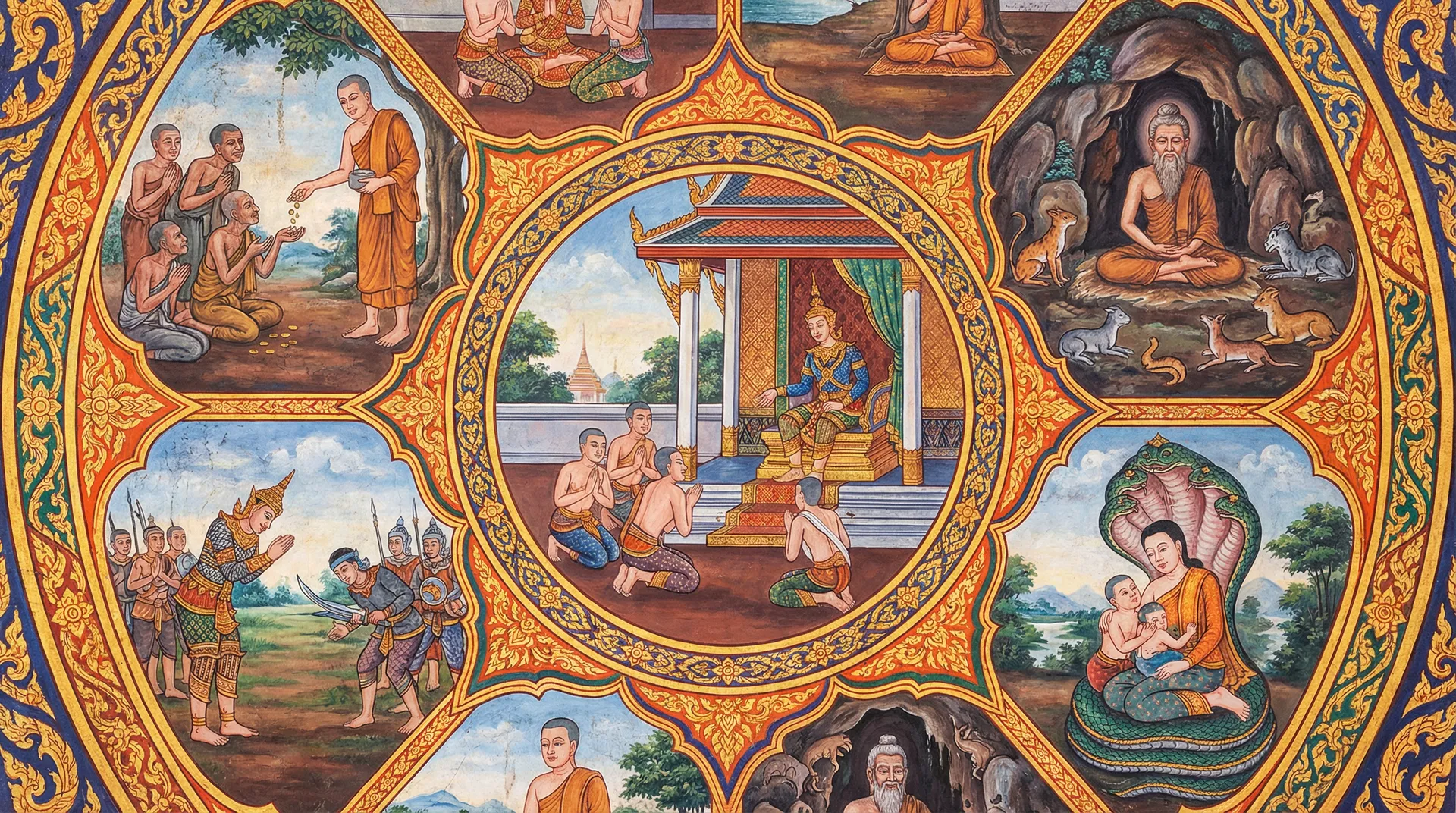
MAHAPADUMA JATAKA
MAHAPADUMA JATAKA
In the ancient Kingdom of Mithila, ruled a king named Dighiti, a benevolent monarch whose reign was marked by peace and prosperity. His queen, Sumitta, was his beloved consort, and together they cherished their young son, Prince Mahapaduma, a child of remarkable beauty and gentle disposition. The king, deeply devoted to his wife and son, often expressed his love for them in grand gestures, showering them with gifts and affection.
However, unbeknownst to the king, a dark seed of envy had taken root in the heart of his younger sister, Princess Paduma. Driven by an insatiable desire for power and a bitter resentment towards Queen Sumitta, whom she believed had usurped her rightful place in the king's affections, Paduma plotted a wicked scheme. She secretly coveted the throne and the king's undivided attention.
One day, while King Dighiti was away on a royal tour, Princess Paduma seized her opportunity. She approached the young Prince Mahapaduma, who was playing in the palace gardens, his laughter echoing through the trees. "My dear nephew," she cooed, her voice dripping with false sweetness, "your father has sent me to take you on a special excursion. We are going to visit the beautiful lotus pond beyond the city walls. You will love it there!"
Mahapaduma, trusting his aunt implicitly, readily agreed. He was a naive and innocent child, unaware of the darkness that lurked behind his aunt's smiling facade. Princess Paduma, along with her co-conspirator, a wicked servant named Kalaka, led the young prince away from the palace. As they reached a secluded grove, far from prying eyes, Paduma signaled to Kalaka.
With a brutal swiftness, Kalaka seized the young prince and, at Paduma's command, plunged a dagger into his heart. The innocent prince's life was extinguished in an instant, his blood staining the verdant earth. Paduma, her heart hardened by her ambition, felt no remorse. She then ordered Kalaka to dispose of the prince's body in a way that would cast suspicion on the queen. They dragged the lifeless body to the queen's private chambers and placed it on her bed, hoping to frame her for the heinous crime.
When King Dighiti returned, he was met with the horrific discovery. The sight of his beloved son, murdered and placed on his queen's bed, sent a wave of shock and grief through him. Overwhelmed by sorrow and misled by Paduma's cunning accusations, the king, in his rage and despair, ordered the execution of Queen Sumitta. The queen, proclaiming her innocence until her last breath, was banished from the kingdom, her heart broken and her reputation shattered.
Princess Paduma, having achieved her immediate goal, now set her sights on the throne. She manipulated the king, painting herself as the devoted sister who had suffered the loss of her nephew. The king, consumed by grief and deceived by his sister's performance, began to rely on her more and more. However, the weight of his son's death and the perceived betrayal of his queen gnawed at him. He became increasingly melancholic and withdrawn.
Meanwhile, Queen Sumitta, though banished, found refuge in a remote hermitage. Her heart ached for her son, but she held onto the truth of her innocence. She lived a life of austerity, dedicating herself to spiritual practices, waiting for the day justice would prevail.
Years passed. Prince Mahapaduma, in his past life as the Bodhisattva, had cultivated immense merit. His spirit, though departed from his physical body, was not lost. In a divine realm, a celestial being, witnessing the injustice and the suffering caused by Paduma's greed, decided to intervene. The celestial being, taking the form of a wise old ascetic, appeared before King Dighiti.
The ascetic, with eyes that seemed to hold the wisdom of ages, spoke to the king. "Your Majesty," he said, his voice calm yet resonant, "the truth of your son's death is not what it seems. The one who orchestrated this tragedy is closer to you than you know." He then recounted the entire tale of Princess Paduma's treachery and Kalaka's complicity, revealing how they had framed the queen.
King Dighiti, initially stunned, listened intently as the ascetic laid bare the horrifying truth. The king's grief transformed into a burning anger, and a deep sense of remorse for his unjust actions against his queen washed over him. He immediately ordered the arrest of Princess Paduma and Kalaka. Paduma, confronted with the evidence and the revelation of her crime, confessed her sins. Kalaka, similarly apprehended, also confessed his role.
The king, filled with profound regret, sent messengers to find Queen Sumitta. When she returned, frail but dignified, the king fell at her feet, begging for forgiveness. "My queen," he wept, "I have been a fool, blinded by deceit. I wrongly condemned you, and for that, I can never truly atone. But know this, I have brought the true perpetrators to justice."
Princess Paduma and Kalaka were punished according to the laws of the kingdom. King Dighiti, seeking to make amends for his grave error, abdicated the throne in favor of his queen, acknowledging that she had borne the brunt of his misguided judgment. Queen Sumitta, despite her suffering, displayed immense magnanimity. She did not seek revenge but ruled with wisdom and compassion, ensuring justice and peace returned to Mithila.
The story of Prince Mahapaduma became a legend, a cautionary tale about the destructive power of envy and ambition, and the ultimate triumph of truth and justice, even when veiled by deception.
— In-Article Ad —
💡Moral of the Story
Envy and ambition are destructive forces that lead to heinous crimes and immense suffering. Truth and justice, though sometimes delayed, will ultimately prevail. True royalty is characterized by wisdom, compassion, and the ability to admit and atone for one's mistakes.
Perfection: Truthfulness
— Ad Space (728x90) —
More Jataka Tales You May Enjoy
 181Dukanipāta
Pañcabrāhmaṇa Jātaka
The Tale of the Five BrahminsIn the ancient city of Mithila, nestled beside the gently flowing Gange...
💡 True wisdom lies not in the accumulation of knowledge, but in self-understanding, humility, cooperation, and the courage to overcome inner fears. Superficial learning is useless without inner strength and practical application.
 536Mahānipāta
Mugapakkha Jataka
The Tale of the Mute Prince In the ancient kingdom of Mithila, nestled amidst rolling hills and verd...
💡 True wisdom and leadership are not always expressed through words. Silence can be a powerful testament to inner understanding, compassion, and enlightenment. Actions and presence can speak louder than any speech.
 50Ekanipāta
The Bodhisatta as the King of the Sarabha
The Bodhisatta as the King of the SarabhaIn the wild and untamed Himalayas, where snow-capped peaks ...
💡 True courage lies in selfless sacrifice for the protection of others, demonstrating profound compassion.
160DukanipātaRohana Jataka
Rohana JatakaIn the ancient city of Ujjeni, a hub of trade and culture, lived a wealthy merchant nam...
💡 True wealth lies not in hoarding material possessions, but in sharing them to alleviate the suffering of others.
144EkanipātaMaca Hamsa Jataka
The Tale of the Golden Swan King In the realm of the Himalayas, amidst snow-capped peaks and crystal...
💡 True wealth lies in inner virtue, wisdom, and compassion, not in material possessions which are transient.
 271Tikanipāta
Nimi Jataka
Nimi JatakaLong ago, in the ancient city of Mithila, ruled a wise and just king named Nimi. His reig...
💡 True fulfillment is found not in escaping worldly duties for heavenly pleasures, but in embracing one's responsibilities with virtue and compassion, thereby continuing spiritual growth amidst life's challenges.
— Multiplex Ad —